Wild Cherry Tree


Everything you need to know about the wild cherry tree, from identification tips to typical characteristics; wild cherry mythology and value to the environment; how to identify disease and the best methods of cherry tree care.

There are many types of cherry tree; all of them part of the same family that produces peaches, plums and apricots. Some cherry trees are native to the UK, others are not so but nonetheless prevalent in this country. Here we are looking specifically at the wild cherry, a UK native species.

General Facts

Known as Wild cherry, gean (Scotland)
Latin name Prunus avium
Location UK and all of Europe except the far north
Foliage Deciduous
Lifespan Up to 60 years

Characteristics

Height Up to 30 metres
Spread More than 8 metres
Appearance Deep reddish/purple-brown smooth, shiny bark with noticeable cream/grey coloured horizontal lines. Very attractive and ornamental in appearance, often with eye-catching trailing branches that sprawl wide from the trunk and a cascade style. In the winter the twigs can be identified by oval shaped clustered buds.
Leaves Green in colour and oval in shape; toothed with pointed tips and slightly straight lines that look like veins running through. Measure between 6 and 15cm and bear two notable red glands on the stalk at the base of the leaf. Transform through green in spring then orange through to deep crimson in the autumn.
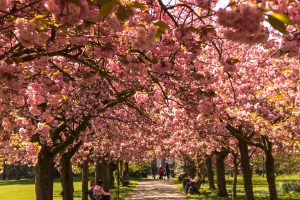
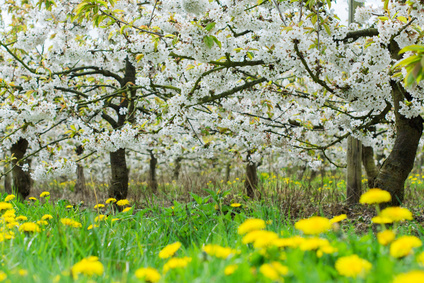
Flowers White, cup-shaped flowers appear in April, each bearing five petals and measuring between 8 and 15mm in width and hanging in clusters of 2-6.
Fruit Once pollinated by insects the flowers develop into smooth fruits starting yellowy-red then fully ripening to a deeper reddish purple. The fruits bear a single stone.
Found in Gardens

Conditions

Ideal soil Wild cherry trees prefer moist but well-drained fertile sand, clay, chalk or loam soil
Soil pH Alkaline, neutral, acid
Aspect South, north, east or west facing
Exposure Full sun

Threats

Pests Aphids, caterpillars, leaf-mining moths, bullfinches, cherry blackfly
Diseases Silver leaf disease, bacterial canker, blossom wilt

Wild Cherry Tree Fruits

Wild cherry trees produce both male and female flowers, so you’ll only need to have one in your garden to produce fruit.

The fruits of the wild cherry tree start to appear once the April blossom has subsided. At first they appear yellowy-red and then gradually transform as they ripen to dark red-purple by July. The fruits of the wild cherry tree tend to have a more tart or bitter taste than some of the sweeter varieties and are less fleshy.

If you are keen to harvest your wild cherry crop for yourself then you’ll have a battle against the birds that will probably have had their beady eyes on the developing fruits for some time, so you may wish to consider protecting your tree with a net where possible – or just be quick! The second part of the botanical name of the wild cherry, ‘avium’, means ‘birds’, so now you know how it got its name.

Wild cherries, being tarter in flavour, make excellent pies and jams.

Wild Cherry Trees and Wildlife

The spring flowers of the wild cherry tree offer a font of pollen and nectar for bees. The cherries themselves are favourite fodder for the song thrush and blackbird and are also much loved by the dormouse, the wood mouse, the yellow necked mouse and the badger.

Caterpillars of various moth species tend to indulge on the leaves. These include the short cloaked moth, the brimstone moth, the orchard ermine moth and the cherry fruit and cherry bark moths.

Wild Cherry Tree Symbolism

The wild cherry is thought to have had enigmatic qualities according to Highland folklore and in those days to come across a wild cherry tree was considered fortunate.

Wild cherry folklore is also associated with the cuckoo. It was said that this bird cannot stop singing until it has eaten three good meals of cherries. In Scotland, the wild cherry is known as ‘gean’. This is thought to have been derived from ‘guigne’, a French word for cherry.

Years ago the resin that leaks from the trunk was recorded as a cough treatment and was often dissolved in wine to treat gall stones and kidney stones.

The Importance of Wild Cherry Trees

If you can beat the birds, the wild cherry tree will provide a delicious crop of fruit which can be eaten naturally or made into pies or used to flavour alcoholic drinks such as brandy, gin and whisky.

Cherry tree wood is very important in furniture making. With its hard, robust and fine-grained composition and prominent, characterful burls it is ideal for this purpose and will often be used in the crafting of high-end cabinetry and decorative veneers thanks to its deep brown hue which polishes to a brilliant shine.

Wild cherry trees are very attractive, particularly when blossoming, and the Woodland Trust recommends they make a wonderful addition to any wildlife garden, providing space is not at a premium due to the potential height and span.

Caring for a Wild Cherry Tree

Wild cherry trees call for expert pruning to encourage a strong branch structure in order to support the heavy fruit crops. Pruning will also allow for improved airflow which will enhance the quality of the fruit. It also makes harvesting easier and helps to thwart disease.

With cherry tree pruning, the objective is to promote an open and well balanced branch structure. Get it right at an early age and the tree will enjoy a good form that allows for healthy fruit yields and overall good health.

It is very important to prune a wild cherry tree at the right time of year, and in the correct way. Failure to do so could result in damage to the tree. There is also a host of diseases and pests to look out for. Read more about cherry tree pruning and care.

The best possible advice is to engage the services of a qualified tree surgeon to assist you in taking care of your wild cherry tree. That way you can feel reassured that it will thrive for many years to come, producing healthy and abundant crops of fruit and providing excellent aesthetic pleasure.

If you have a wild cherry tree on your land that needs expert tree care, why not talk to Tree Works? As fully qualified and highly experienced tree surgeons, we are able to offer exceptional knowledge on all aspects of wild cherry tree care. For a free, no-obligation quotation, give us a call on 07781 416 354 or get in touch here.
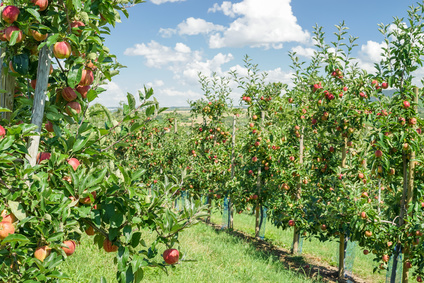
Domestic Apple Tree


Everything you need to know about the domestic apple tree, from identification tips to typical characteristics; how to spot disease and the best methods of apple tree care.

Whilst the domestic apple tree is not native to the UK, it is exceptionally popular across the country and a real favourite of the English garden. There are over 7,500 cultivated apple varieties across the world making this a truly versatile tree, well known for its striking blossom. Not to be confused with the crab apple, which is native to the UK, the common apple bears a huge variety of much larger fruits including the Gala apple, the George Cave apple and the Chivers Delight apple as well as the much renowned Golden Delicious apple.

General Facts

Known as Apple, domestic apple
Latin name Malus x domestica
Location Originated in Central Asia, now found across Asia, Europe and North America
Foliage Deciduous
Lifespan Up to 50 years

Characteristics

Height 4-10 metres
Spread 4-10 metres
Appearance A small to medium sized tree with eye-catching pink to white flowers that appear in late spring followed by ornamental or edible fruit in autumn. Usually maintain good autumn foliage colour.
Leaves Apple tree leaves are dark green in colour and oval shaped with serrated edges. The underside of the leaves is notably woolly or furry in texture.
Flowers Apple tree flowers are white with hints of pink and bear five petals. They grow in clusters and create a striking display throughout May and June.
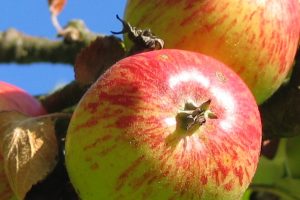
Fruit Apple tree fruits range in colour from green to red and can be sour or sweet to taste. The fruits contain a carpel or core that contains a few dark brown seeds. Some fruits are grown specifically for cooking or cider making, whilst others are perfect for eating naturally.
Found in Hedgerows, scrub, copses, roadsides, gardens

Conditions

Ideal soil The domestic apple enjoys a deep and fertile loam, clay or sand soil, moist but well-drained
Soil pH Alkaline, neutral, acid
Aspect South, east or west facing
Exposure Full sun

Threats

Pests Aphids, caterpillars, codling moth, mussel scale
Diseases Apple scab, canker, bitter pit, brown rot, powdery mildew, apple sawfly, apple sooty blotch, fly speck

A Selection of the Different Varieties of Domestic Apple

There are so many different apple cultivars that fall under the category of domestic apple. Here are some of the most popularly grown in UK gardens:

Chivers Delight: A dessert apple that becomes ready to pick in mid-autumn and that will store until mid-winter. Depending on the level of sunshine it has been exposed to, the fruits will appear a red-flushed, yellow with sweet-flavoured crisp, juicy flesh.

Blenheim Orange: This apple offers an almost spicy flavour with a soft nuttiness. Best grown alone due to its tendency to develop apple scab, the tree tends to grow vigorously and does well in cold, wet climates. The apples are yellow-green in colour and gradually become a flushed orange-red. Use from late September for cooking and from October to January for eating.

Discovery: This is an early season apple and one of the first to harvest in August. Depending on the level of sunshine through July and August, the bright redness from the skin can filter into the flesh which on pressing serves up a delicious pale pink juice. Fruits will only tend to last to September.

Egremont Russet: A well-known apple with a characteristic nutty texture and a floral taste that captures the essence of the blossom. It’s good for storing, and the flavour will mature to honey over time. Apples are yellow-green, ripening to a half-flushed brown-red hue covered with russet. Use from October to December.

Gala: A dessert apple that appears in mid to late season after the pink and white blossom has subsided. Pick during the autumn and store till mid-winter. Yellow-skinned with a red, striped flush. The flesh is juicy and creamy with a rich flavour.

Golden Delicious: One of the most popular and well known apples, Golden Delicious is a dessert apple that acts as a good pollinator for other apple trees. Fruits are greenish yellow to start with then grow yellower as they mature. Once they are fully ripened, these apples are honey-sweet. These fruits store very well and will last through from November to February.

Scrumptious: A bright red dessert apple that follows pale pink flowers. The flavour is complex and fragrant with honeyed tones. The fruit has a short season, only from September to October.

Domestic Apple Trees and Wildlife

Apples are a favourite source of food amongst wildlife. Thrushes and bullfinches enjoy the buds, whilst blackbirds seek out bushier apple trees as an ideal nesting spot.

Domestic Apple Tree Symbolism and History

The apple is considered the fruit of fertility and eternal youth according to Norse mythology. It is reckoned that if you fall asleep in an orchard, you may wake up several years later, and that treasure buried under an apple tree will never rot, nor be found. Halloween apple bobbing is said to have come about because the combination of the water and fruit has the power to put you in touch with the fairy kingdom and if you take a bite from an apple on Halloween then sleep with it under your pillow, you will dream of your true love.

Apples originated in Eastern Europe and, as travellers through the fruit forests ate the fruit and discarded the pips, so the trees spread across Europe and into the Baltic regions.

Henry VII was said to pay significant sums for individual apples, and Henry VIII had his own orchard in Kent where many different varieties were grown. He even imported French gardeners in to tend to them. Catherine the Great adored Golden Pippin apples so much that she would have them brought to her Russian palace, each wrapped in paper made from real silver. Queen Victoria also adored apples, especially of the baked variety, and it was during her reign that there was a huge increase in the number of apple varieties being grown.

The Importance of the Domestic Apple

The domestic apple and its many cultivars are used for eating, cooking and cider production. Apple wood doesn’t tend to be used for general furniture making as it is a high density timber and is therefore challenging to work with, however it is used occasionally for fine carving.

Caring for a Domestic Apple Tree

The domestic apple tree needs a lot of care and attention if it is to grow strong and healthy and produce large crops of tasty, quality fruit. Apple tree pruning can be quite a complex task and the process must be specific to the individual cultivar, root stock and training form.

Sadly it is not uncommon for people to halt the growth of an apple tree and destroy or reduce its fruit producing capabilities through inappropriate pruning. There are also numerous threats to the apple tree, which means paying close attention to the health of the tree is vital in order to spot the early signs of disease and pest infestations.

Read more about Apple tree care and pruning.

The best possible advice is to engage the services of a qualified tree surgeon to assist you in taking care of your domestic apple tree. That way you can enjoy total peace of mind that it will flourish for many years to come, producing healthy and plentiful crops of fruit and providing excellent aesthetic pleasure.

If you have a domestic apple tree on your land that needs expert tree care, why not talk to Tree Works? As fully qualified and highly experienced tree surgeons, we are able to offer exceptional knowledge on all aspects of domestic apple tree care. For a free, no-obligation quotation, give us a call on 07781 416 354 or get in touch here.
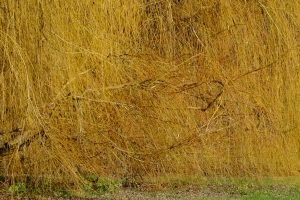
Weeping Willow Tree


Everything you need to know about the weeping willow tree, from identification tips to typical characteristics; how to spot disease and the best way to maintain a willow tree.

There are around 400 species of willow tree, known in Latin as Salix meaning ‘sallow’. Generally when you hear mention of a willow tree, you tend to naturally think of the ‘weeping willow’, or Salix babylonica. The long, elegant trailing branches that are characteristic to the weeping willow tree swish gracefully in the breeze, providing a much welcome haven for shade-seekers and wildlife alike.

The weeping willow is an extremely fast growing tree that has a long history in Great Britain and, despite it having originated in China, is now very prevalent nationwide. It is one of the UK’s largest weeping trees and the sight of a weeping willow looming magnificent over a glistening lake has become quintessentially English.

General Facts

Known as Weeping Willow
Latin name Salix babylonica
Location Europe, North America, Asia
Foliage Deciduous
Lifespan 30-50 years

Characteristics

Height 10 – 18 metres
Spread 10 – 18 metres
Appearance Striking and unmistakable in appearance, the weeping willow sports attractive trailing branches and a distinctive rounded shape. It will usually be found alongside water.
Leaves Elongated, narrow leaves, green on the top and white on the bottom with a fine toothed margin. Leaves transform through green when they appear in the spring to yellow in the autumn.
Flowers Yellow flowers appear in early spring. They are small and appear as catkins. Their richness in nectar attracts an abundance of insects.
Fruit Edible fruit is smooth and oval Once the catkins are pollinated, they develop into 3mm long, brown, conical capsules.
Found in Wet, boggy locations such as beside lakes, ponds, rivers and streams; popular in parks, maintained gardens and larger domestic gardens.

Conditions

Ideal soil Wet and boggy sand or clay soil; regular watering and mulching essential in the first year of planting and until established
Soil pH Acid, alkaline
Aspect North, south, east or west facing
Exposure Full sun and partial shade

Threats

Pests Gypsy moth caterpillar, willow leaf beetle, bagworm
Diseases Crown gall, willow scab, black canker, sunscald

Willow Trees and Wildlife

Willow trees offer abundant shelter for wildlife. The flowers of the weeping willow produce ample pollen and nectar and so are a favourite for bees, butterflies and moths. Birdlife thrives on caterpillars which are particularly beneficial for baby birds. The cascading branches provide refuge for nesting birds from predators, which will also turn to the tree’s leaves, twigs and seeds for sustenance. Woodpeckers are attracted to the borers that the willow tree is a haven for.

Deer are partial to weeping willows but being a hardy tree, the willow rarely experiences permanent effects from the nibbling.

Various animals including rabbits and squirrels are attracted to the weeping willow, particularly those that provide hidden shelter by way of craggy cavities.

Weeping Willow Tree Symbolism

The willow tree has long been associated with metaphysical and ritual practices. Willow wood has been used throughout history – and still is – for psychic enhancement ceremonies.

Due to its association with water, the willow tree is connected with magic and power. The Greek goddess of witchcraft, Hecate, used willow wood to make her wands, whilst Orpheus, the bringer of song, used the wood as a talisman against evil on his route to the underworld. The harp that Apollo gifted to Orpheus was also said to be crafted from willow.

Dating back to 1583, William Shakespeare’s Willow Song in Othello is possibly the most famous literary reference to the willow tree. The Baird mentioned the tree again in Hamlet and Twelfth Night and Harry Potter author J.K. Rowling’s Whomping Willow is the well-known keeper of the tunnel that leads to the Shrieking Shack where Professor Lupin secretes himself during his transformations into a werewolf.

The Importance of Willow Trees

Willow trees produce a milky sap which contains salicylic acid which is used to make aspirin, an exceptionally important pain relief drug used worldwide. Years before aspirin became commonplace, people would chew willow bark to treat fever, inflammation and pain. Willow bark, often taken as a tea, continues to be used as an alternative remedy for a number of health issues to this day.

The willow tree’s natural ability to absorb large quantities of water makes it ideal for planting in flood prone areas or where drainage is required.

Willow wood is used to produce a vast array of items including cricket bats, furniture, toys, fishing nets, baskets, musical instruments and broom handles.

The willow is a very important tree!

Caring for a Willow Tree

Willow trees are fast growing and benefit from regular trimming of the hanging branches so that the area underneath the tree can be enjoyed as a shady haven, and so that it can be more easily maintained.

Shaping and pruning in the tree’s early years is essential to create a strong structure that will pretty much look after itself in maturity, aside from branch trimming, dead wood and lower branch removal and taking out any suckers. You can read more about Willow tree pruning here.

Willow trees tend to grow to substantial heights and widths, which means willow tree pruning and branch trimming should be left to professionals who are trained in safe working at height, particularly if the willow tree is located close to a body of water. In addition, the willow tree is prone to a number of diseases and pests such as crown gall and willow scab, and it will often take a qualified arborist to identify whether something is not right. Early detection is vital if the health of the tree is to be maintained.

If you have a willow tree on your land that needs expert care, why not talk to Tree Works? As fully qualified and highly experienced tree surgeons, we can offer comprehensive knowhow across all aspects of willow tree care. For a free, no-obligation quotation, give us a call on 07781 416 354 or get in touch here.
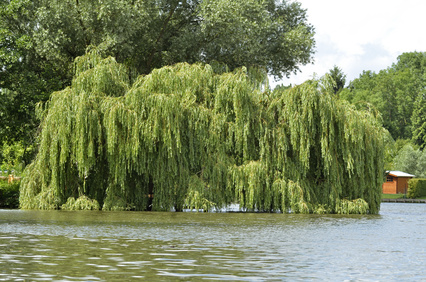
Yew Tree


Everything you need to know about the yew tree, from identification tips to typical characteristics; how to spot disease and the best way to maintain a yew tree.

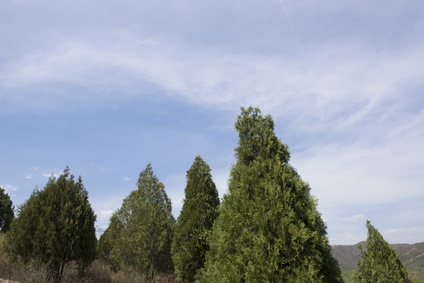
The yew tree is a UK-native evergreen conifer, well known for living to a grand age of 400 to 600 years. It is believed and stated by the Woodland Trust that there are ten yew trees in Britain that predate the 10th century, so this is a tree with exceptional history and one we should be proud of as a nation.

There are various types of yew tree, including the Irish yew, English yew and numerous common yews including Icicle and Standishii which vary greatly in appearance, height and overall size from half a metre up to 20 metres. It is a popular tree for hedge forming as it provides year-round privacy screening and its red berry like fruits are very eye-catching.

General Facts

Known as Yew, English yew, common yew
Latin name Taxus baccata
Location Europe, West Asia
Foliage Evergreen
Lifespan 400-600 years

Characteristics

Height Up to 20 metres depending on variety
Spread 8 metres plus
Appearance A medium sized bushy evergreen tree with red berry-like fruits that give the plant a ‘Christmas-like’ appearance. Bark is reddish-brown with hints of purple. Often shaped with topiary and a very popular hedging plant.
Leaves Narrow, leathery leaves, very dark green in colour and arranged in two rows along the shoots.
Flowers Flowers appear in March and April. Male flowers are insignificant yellowish-white round structures. Female flowers are scaly in texture and more bud-like, starting off green then browning to an acorn-like appearance.
Fruit Edible fruit is smooth and oval Unlike most other conifers, yew tree fruits do not take on a cone-like appearance. Instead they are more berry-like; they are called arils and are red and fleshy and open at the tip.
Found in Very popular in southern England as a hedging plant. Often found in churchyards, and in courtyard gardens as stylised topiary.

Conditions

Ideal soil Any well-drained chalk, clay, sand or loam soil makes a good foundation for the yew tree which is hardy enough to withstand urban pollution and dry conditions.
Soil pH Acid, alkaline, neutral
Aspect North, south, east or west facing
Exposure Full sun, full shade and partial shade

Threats

Pests Tortrix moth, vine weevil, gall mites, scale insects
Diseases Phytophthora root rot

Yew Trees and Wildlife

Due to their denseness, yew trees offer exceptional protection for birds, as well as excellent nesting opportunities. Blackbirds, mistle thrush, song thrush and fieldfare enjoy the fruits of the yew tree, as do dormice and squirrels. The caterpillars of the satin beauty moth will often feast on the leaves.

Yew Tree Symbolism

Yew trees have a historical association with churchyards. In England there are at least 500 churchyards where yew trees grow and where these trees are said to be older than the building itself.

It is believed that yew trees were planted on the graves of plague victims in order to purify and protect them.

The yew tree is a symbol of immortality. The branches were carried on Palm Sunday and at funerals by tradition for many centuries. It is known as the ‘tree of resurrection’ and the ‘tree of eternity’ and is symbolic as the tree of life, which is very popular as jewellery pendants and symbolises protection, longevity, change, divinity and strength. In medieval times, yew was burned to assist in contacting passed over spirits.

The Importance of Yew Trees

Yew is a very popular, slow-growing, self-maintaining hedging and topiary plant, used extensively in courtyard and heritage gardens and is one of the most commonly used plants to create mazes.

Yew wood has been used for thousands of years and was historically the timber of choice to make tool handles and long bows. In 1911, a yew spear head was unearthed in Clacton-On-Sea which is reckoned to be in the region of 450,000 years old.

The close-grained denseness, rich warm sunny brown tone and narrow annual growth rings make yew strong and incredibly eye-catching, which is why it has become one of the most sought-after timbers by high-end furniture crafters.

The leaves of the yew tree produce anti-cancer compounds which are used in modern medicine. However, it is important to be aware that yew trees are in fact poisonous to humans and many mammals if ingested. Just a few leaves could induce serious illness in a child, and fatalities have been known. All parts of the tree are poisonous apart from the arils (berries), although even the black seeds inside them are toxic.

Caring for a Yew Tree

Yew trees do not call for much care and attention as they are slow growing, although they can be trimmed to keep them in shape. This is usually done twice a year, once in spring and then again in summer. Otherwise pruning really is mostly for show, although it is important to regularly check for signs of pests including the tortrix moth, the vine weevil, gall mites and scale insects. A periodic check for Phytophthora root rot is also important.

If you have a yew tree or any type of conifer tree on your land that needs expert care, why not talk to Tree Works? As fully qualified and highly experienced tree surgeons, we can offer comprehensive knowhow across all aspects of yew tree care, including a professional topiary service. For a free, no-obligation quotation, give us a call on 07781 416 354 or get in touch here.

Hawthorn Tree


Everything you need to know about the hawthorn tree, from identification tips to typical characteristics; how to spot disease and the best way to maintain a hawthorn tree.

The hawthorn tree, also commonly known as the May tree on account of its blooming period taking place during the month of May, is a bushy deciduous tree, small in stature and renowned for its dark red autumn berries which follow sprays of pretty cream flowers.

The hawthorn, a UK native species, is a long living tree which can reach a ripe old age of 400 years. It is often used as hedging and as an ornamental shrub in town centres and around coastal locations, as well as being a popular installation in wildlife gardens on account of its appeal to as many as 300 insects which feast on its leaves. Hawthorn flowers deliver an enjoyable meal for dormice too, as well as providing ample nectar for pollinating insects such as bees.

General Facts

Known as Hawthorn, common hawthorn, May
Latin name Crataegus monogyna
Location Europe, South West Asia, North Africa
Foliage Deciduous
Lifespan 400 years

Characteristics

Height Up to 15 metres
Spread 4 – 8 metres
Appearance A thorny, bushy, dense tree with brown-grey bark that is characteristically fissured and knotted. Twigs are brown, thin and thorny.
Leaves Leaves are deeply lobed and glossy, around 6cm in length. Starting green in spring, they eventually turn yellow before falling in autumn.
Flowers The highly scented hawthorn or May flower is usually white although can sometimes be pink. Flowers are made up of five petals and grow together in clusters.
Fruit Once pollinated, the trees produce deep red fruits known as ‘haws’ which can be used to make wine, jellies and ketchups
Found in Woodland, scrub, hedgerows, ornamental displays

Conditions

Ideal soil The hawthorn tree prefers moist but well-drained soil and will grow well in chalk, clay, sand or loam
Soil pH Acid, alkaline, neutral
Aspect North, south, east or west facing
Exposure Full sun or partial shade – flowers and fruits appear best in full sun

Threats

Pests
Diseases

Hawthorn Trees and Wildlife

The hawthorn is a very important tree where wildlife is concerned. It will provide sustenance for in excess of 300 insects together with a variety of moth caterpillars including the hawthorn moth, orchard ermine, lappet, small eggar, fruitlet mining, light emerald and pear leaf blister amongst others.

Dormice enjoy the flowers, which also deliver a rich source of nectar for pollinating insects such as bees.

The fruits are plentiful in antioxidants which makes them a healthy meal for numerous birds, in particular the thrush, fieldfare and redwing, as well as smaller mammals. Birds also particularly enjoy the nesting opportunities offered by the dense prickly foliage which provides excellent protection from predators.

Hawthorn Tree Symbolism

The hawthorn or May tree is surrounded by much myth and lore and is respected as a ‘tree of enchantment’.

It is said that the essence of the hawthorn tree cleanses the heart of negativity, stimulating forgiveness and love. Its flowers are said to help prayers reach heaven.

Associated with May Day, the original May Poles were made of hawthorn. It is said that if you sit under a hawthorn on 1st May, you could well be whisked away forever to the realm of the faeries.

Back in medieval times, hawthorn trees were woven into hedgerows and used to protect villages from highwaymen.

The traditional saying, ‘Never cast a clout till May be out’ is long misunderstood, with many people believing it is suggesting you should not discard your winter clothing until the month of May is over. In actual fact, it refers to the hawthorn blossom, the May flower, so the true meaning is, until you see the hawthorn tree in bloom, keep those woollies handy!

The Importance of Hawthorn Trees

Hawthorn wood is very hard thanks to its fine graining. It is also very attractive, sporting creamy brown tones, making it popular amoungst cabinetmakers. It works well as a natural wood veneer and is widely used in the making of tool handles and boat parts. It’s also popular as firewood and charcoal as it can burn at high temperatures.

As well as the tree’s importance to wildlife, the hawthorn tree is a popular choice for hedging thanks to its slow growing habit and ease of care.

Hawthorn flowers and young leaves are often added to salads. The fruits are edible in raw form, but are known in some cases to cause a mild stomach upset. Instead they are more widely used to make ketchups, wines and jellies. If you fancy making your own hawthorn berry wine, here’s a recipe.

Caring for a Hawthorn Tree

The hawthorn tree does not call for a great deal of pruning, although if you are aiming to keep a hedge in a particular shape then you will need to undertake periodical trimming. It is vital not to over-prune a hawthorn tree as this can stunt its growth, and you must never trim this tree until it is well established and at least 1.5 metres in height. If you want to enhance the May blossom once the tree is mature, prune during the winter.

The hawthorn tree is prone to gall mites, aphids and caterpillars so be sure to check for infestations whilst undertaking your pruning. In particular, look out for fireblight, a bacterial disease that kills the shoots of various trees including ornamental shrubs such as the hawthorn tree. If your hawthorn tree appears as though it has been scorched by fire, is displaying wilting blossoms, cankers (sunken bark) and / or oozing white slime during late spring through to autumn, this could be fireblight and you will need to have the affected areas pruned out immediately.

If you are in any way unsure as to the best way to care for your hawthorn tree then you should not hesitate in seeking professional assistance from a qualified tree surgeon. They have the experience and expertise to prune and trim trees in just the right way and at just the right time. They will also know precisely how to identify and deal with any common diseases or pests.

If you have a hawthorn tree on your land that needs professional care, why not talk to Tree Works? As fully qualified and highly experienced tree surgeons, we can offer comprehensive knowledge and skill across all aspects of hawthorn tree care, including a professional topiary service. For a free, no-obligation quotation, give us a call on 07781 416 354 or get in touch here.

Cedar Tree


Everything you need to know about the cedar tree, from identification tips to typical characteristics; how to spot disease and the best way to maintain a cedar tree.

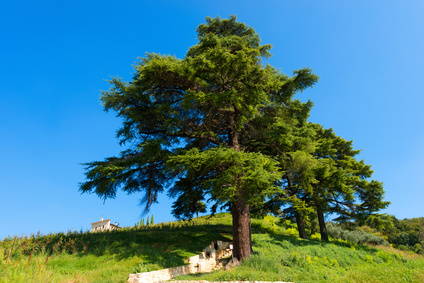
The cedar tree is common in the UK, although it is actually native to the Lebanon and is in fact the country’s national emblem. It is also found in parts of Asia and the eastern Mediterranean. It is an evergreen conifer forming part of the pine family and interestingly, its wood provides protection from insects where the tree grows as a native species.

Considered a popular and eye-catching architectural tree due to its striking appearance, the cedar tree’s low maintenance and next-to-no requirement for pruning makes it a top choice for public grounds landscapers and you will often see cedar trees in estate gardens and parks.

Some scientists recognise two varieties of the cedar of Lebanon, one being the Lebanon variety and the other the Turkish cedar. The tree also has two very close relations, the Cyprus cedar and the Atlas cedar.

General Facts

Known as Cedar, cedar of Lebanon, Lebanese cedar, Mediterranean cedar
Latin name Cedrus libani
Location South West Asia, Syria, eastern Mediterranean
Foliage Evergreen
Lifespan Up to 1,000 years

Characteristics

Height 35-40 metres
Spread 8 metres plus
Appearance A Majestic and eye-catching looking pine tree with a single, thick trunk sprouting numerous spirally arranged branches. Younger cedar trees have a cone-shaped crown, although this flattens and broadens with age to give the tree its characteristic appearance. Bark is dark grey-brown with deep fissures developing into maturity.
Leaves Leaves are dark green and needle-like with transparent tips. They appear in spirals in clusters which are present all year round.
Flowers The female flowers transform into a green cone, developing through grey-purple then brown up to a year after pollination. The male flowers appear on different cones which are smaller, evolving through green-grey to brown.
Fruit The cones measure 8-12cm in length and usually appear every other year. Standing upright at the end of the short shoots and barrel-shaped, they grow singularly and feel papery to touch with a flattened top. Male cones are cylindrical whilst the female cones are rounded and covered in seed scales which are released when the cone reaches maturity and breaks up.
Found in Parks and gardens are the most popular homes for cedar trees in the UK. Overseas they tend to grow in mountainous regions or in mixed forests with fir, pine, oak and juniper species.

Conditions

Ideal soil Any well-drained chalk, clay, sand or loam soil is ideal for the cedar tree
Soil pH Acid, alkaline, neutral
Aspect North, south, east or west facing
Exposure Full sun

Threats

Pests Aphids
Diseases Honey fungus

Cedar Trees and Wildlife

Cedar trees are not thought to have much of a connection with wildlife.

Cedar Tree Symbolism

The cedar tree is the national emblem of Lebanon and was notably used to construct the Temple of Solomon in Jerusalem together with the temples and ships of the Egyptian pharaohs who also used the resin of the tree for mummification.

The cedar tree is well known for its spiritual significance and has been for many thousands of years. The wood was burned in cleansing ceremonies for purification and it is said to be a Jewish custom to burn cedar wood to welcome in the New Year.

The cedar tree was also thought to house important gods and to provide a gateway to higher realms.

The English word cedar comes from the Hebrew ‘qatar’ which means to smudge, which is where the burning of the timber derives from. In the Himalayas cedar is known as ‘deodar’ which comes from the Sanskrit ‘devdar’, meaning ‘timber of the gods’.

The Importance of Cedar Trees

Cedar wood is of exceptional quality and durability and has been used for thousands of years in construction and, in more recent centuries, in furniture making. The wood retains a sweet fragrance for many years and is commonly used to produce oils. Cedarwood oil is an essential oil which is used as a natural insect repellent and an antiseptic as well as to uplift and comfort.

Caring for a Cedar Tree

Cedar trees do not call for too much in the way of regular attention and certainly do not need very much pruning, even during their formative years. Only in situations where a tree has outgrown its space might it be necessary to very, very carefully prune a cedar tree and this must be done with exceptional caution and only during its dormant period. Incorrect pruning of a cedar tree can easily lead to permanent destruction of its appearance and sometimes also its death.

Keeping an eye on the tree and checking for signs of honey fungus though is a good idea. Look out for decaying roots, white fungus between the wood and the bark and rhizomorphs which are all symptoms of this disease. Thankfully though the cedar tree is not nearly as susceptible to pests and diseases as other trees.

If you have a cedar tree or any type of conifer or pine tree on your land that could do with some expert care and attention, why not talk to Tree Works? As fully qualified and long term experienced tree surgeons, we can offer comprehensive knowledge and skill across all aspects of cedar tree care. For a free, no-obligation quotation, give us a call on 07781 416 354 or get in touch here.
Eucalyptus Tree


Everything you need to know about the eucalyptus tree, from identification tips to typical characteristics; how to spot disease and the best way to maintain a eucalyptus tree.

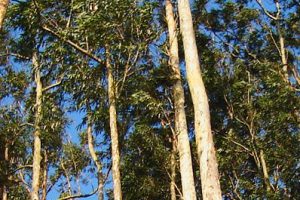
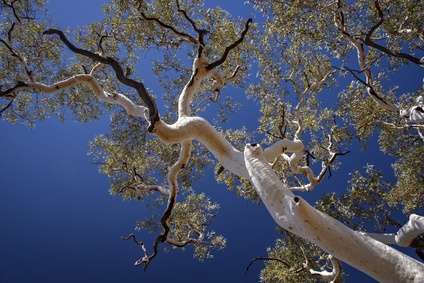
The highly aromatic and fast growing eucalyptus tree is native to Australia and only around 12 of its numerous species grow in Europe’s warmer regions. Also known as the gum tree due to the red coloured resin that oozes from the bark, the eucalyptus tree will vary quite substantially in appearance, from a short bushy shrub through to a tall evergreen tree up to around 30 metres in height.

Eucalyptus is part of the very large Myrtaceae otherwise known as ‘myrtle’ of which the bay rum tree, guava, clove and allspice also belong. Only the hardiest variations of the species do well in Britain due to its preference for a warmer climate.

The cider gum tree (Eucalyptus gunnii) is found in abundance on the Essex coast, and the Tasmanian blue gum (Eucalyptus globulus) is in prevalent in Cornwall and Ireland.

General Facts

Known as Eucalyptus, gum tree
Latin name Eucalyptus sp.
Location Australia, Tasmania
Foliage Evergreen
Lifespan 250 years

Characteristics

Height 4-30 metres depending on variety
Spread 2-4 metres
Appearance Eucalyptus trees are evergreen and usually fast growing and will either take on the format of a large shrub or a tree. Some have attractive looking bark that flakes into cream, grey and green patches. Most have aromatic foliage with small yellow, red or white flowers that grow in clusters.
Leaves New leaves on younger trees don’t have stalks and are round and blue in colour. Adult leaves are blue-green in colour. They are long and slender and protrude downwards on single stalks. It is from the adult leaves that eucalyptus oil comes from: crush them and you’ll experience that unmistakable aroma.
Flowers The flower buds take on a cone shape and grow in sets of three on short stalks. Each bud sports a round cap on its top which is known as the ‘calyptus’. This goes on to drop off to reveal a fluffy, sunburst style flower stamen that is a big draw for bees.
Fruit Each flower has a woody, hard pod inside it which releases seeds on opening.
Found in Forestry plantations, parks, gardens, roadsides, woodland

Conditions

Ideal soil Any moist but well-drained or even poorly drained chalk, clay, sand or loam soil is ideal for the eucalyptus tree
Soil pH Neutral, acid
Aspect North, south, east or west facing
Exposure Full sun, shelter when young

Threats

Pests Eucalyptus gall wasp
Diseases Silver leaf, oedema

Eucalyptus Trees and Wildlife

Eucalyptus trees prove a big attraction for pollinating insects like bees.

Due to their high levels of essential oils, the leaves do not hold the same attraction for animals as they find them hard to digest. Of course the exception to the rule in Australia is the koala bear.

Eucalyptus Tree Symbolism

Eucalyptus was traditionally used for spiritual cleansing and the oil of the leaves is still widely put to good use for medicinal purposes.

The indigenous people of Australia would make very good use of the eucalyptus tree, using its wood to craft everything from tools, water bowls and canoes to spears, shields and musical instruments. Leaves of some of the species would be soaked in water to produce a tea with healing properties

The name eucalyptus comes from the Greek eucalyptos which means ‘well-covered’. This refers to the gum nut covering found over the tree’s budding flowers.

The koala bear of Australia lives solely on eucalyptus leaves and myth dictates that it gives the animal a high. However in reality, because digesting the leaves takes a great deal of energy and the leaves don’t really deliver much in the way of nutrition, it results in the koala needing a good 22 hours of sleep a day, which would account for its ‘laid back’ lifestyle.

The Importance of Eucalyptus Trees

Eucalyptus oil is a well-known remedy for coughs, colds and sinus problems, often used in steam inhalers. It also offers effective relief from infections and fevers and will heal wounds.

Eucalyptus oil is widely used as a natural antiseptic and an arthritis remedy and works exceptionally well as a sticky stuff remover. People suffering from depleted energy will also find eucalyptus oil works well to revive their vivacity.

The wood of the tree nowadays is used as timber and its pulp for paper production.

Caring for a Eucalyptus Tree

The eucalyptus tree needs very little if any pruning as it naturally forms a strong framework. Some varieties, such as the cider gum tree, benefit from hard pruning to promote large juvenile foliage. There is a particular process to follow however in order to preserve the good health of the tree, so do seek professional advice from an experienced tree surgeon before you proceed with any pruning.

You’ll need to give your eucalyptus tree plenty of water during dry summers, otherwise come the winter the stems are likely to suffer.

Also look out for eucalyptus gall wasp. This is a tiny black insect that produces larvae that develops inside raised galls that form on the leaves of the eucalyptus tree during the spring. You’ll see raised swellings on either side of the leaves. These are more prominent in early spring when infestations can sometimes cause heavy leaf fall. Whilst the gall wasp does not affect the health of the tree in the long term, it can reduce the attractiveness of its appearance.

If you have a eucalyptus tree on your land that could do with some expert care and attention, why not talk to Tree Works? As fully qualified and long term experienced tree surgeons, we are able to provide in-depth knowledge and expertise across all aspects of eucalyptus tree care. For a free, no-obligation quotation, give us a call on 07781 416 354 or get in touch here.
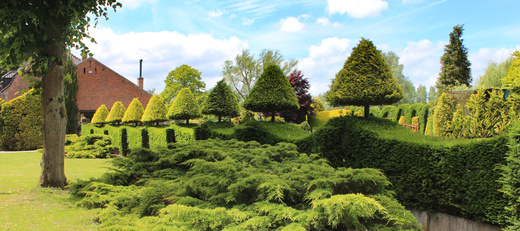
Leyland Cypress Tree


Everything you need to know about the Leyland cypress tree, from identification tips to typical characteristics; how to spot disease and the best way to maintain a Leyland cypress tree.

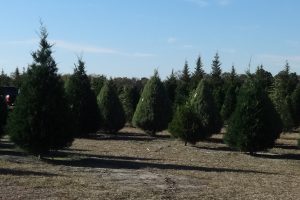
The Leyland cypress is perhaps one of the most infamous conifer trees, well known for its rapid growing habit and towering potential heights of up to 40 metres. Whilst this tree is not native to the UK, it has still become very prominent and is predominantly grown as a boundary hedge in residential gardens, often leading to neighbour disputes.

Many people opt for the Leyland cypress due to its year-round wind and sound absorbing properties and the fact its fast growth provides an almost instant privacy screen, but these trees do benefit from careful pruning and shaping to keep them in check so as to avoid neighbour issues.

General Facts

Known as Cypress, Leyland cypress, Leylandii
Latin name Cupressus x leylandii
Location North America, Australia, New Zealand, Europe
Foliage Evergreen
Lifespan 10-20 years

Characteristics

Height 35-40 metres
Spread 8 metres plus
Appearance A very large, tall evergreen conifer tree with dense foliage that acts as an effective noise and wind break. The tree’s bark, rarely seen through the foliage, is grey-red and ridged. Twigs are flexible, brown and willowy.
Leaves Leaves are deep green to blue-green, soft and scaly and overlap in flat, dense sprays on long stalks. The leaves may cause skin irritation.
Flowers No flowers
Fruit Cones are small and globular in shape and brown in colour. In winter, the male cones are yellow and appear at the tips of the twigs.
Found in Commonly used as privacy hedging in residential gardens in the UK. Increasingly being grown by Christmas tree farmers and commonly used for this purpose in America.

Conditions

Ideal soil Any well-drained chalk, clay, sand or loam soil is ideal for the Leyland cypress tree which prefers moist but not saturated conditions
Soil pH Acid, alkaline, neutral
Aspect North, south, east or west facing
Exposure Full sun to partial shade

Threats

Pests Aphids, scale insects
Diseases Honey fungus, canker

Leyland Cypress Trees and Wildlife

Leyland cypress trees are not thought to offer much in the way of value to wildlife, however the dense foliage does provide a safe haven for garden birds.

Leyland Cypress Tree Symbolism and History

The Leyland cypress came about as the result of a cross between the Monterey cypress and the Nootka cypress, both species native to North America. However, it is pretty much impossible that this cross first occurred in the wild, as the species’ natural habitats are 400 miles apart. Instead it is thought that the Leyland cypress was created by accident in the 19th century in a Welsh garden nursery and discovered by C.J. Leyland, hence its name.

Due to its relative infancy in terms of history, there is no myth, legend or symbolism currently associated with this tree.

The Importance of Leyland Cypress Trees

The Leyland cypress is a popular privacy hedging plant due to its rapid growth. However, anyone growing these trees should make themselves aware of the Anti-Social Behaviour Act 2003: Part 8. If a hedge (a line of 2 or more predominantly evergreen trees) grows to a height in excess of 2 metres, then it will be classed as a ‘high hedge’ which will be governed by legislation designed to protect people from nuisance. You can read more information about nuisance and overgrown hedges here.

Caring for a Leyland Cypress Tree

In general, the Leyland cypress does not call for much pruning, although it does benefit from trimming in order to maintain its shape. Careful pruning should be carried out only between the months of April and August and three cuts can be made during the growing season once the tree is established.

However, it is important to note that this is a conifer tree that will not withstand hard pruning. Cut into old wood and it will not regrow, so stick to pruning only the young green shoots.

You should also keep an eye on the tree and look for signs of canker and honey fungus. If you spot white fungus between bark and wood, rhizomorphs or decaying roots then this could be an issue. Also be on the lookout for brown patches which could be down to the cypress aphid, scale insects, canker or even over-pruning.

If you have a Leyland cypress tree or any type of conifer on your land that could do with some professional care and attention, why not talk to Tree Works? As fully qualified and extensively experienced tree surgeons, we can offer comprehensive knowledge and skill across all aspects of conifer tree care. For a free, no-obligation quotation, give us a call on 07781 416 354 or get in touch here.
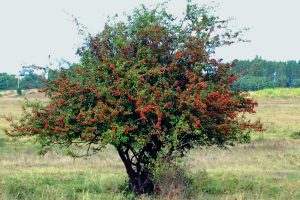
Bay Laurel Tree


Everything you need to know about the bay laurel tree, from identification tips to typical characteristics; how to spot disease and the best way to maintain a bay laurel tree.

The bay tree or bay laurel makes a popular hedging and topiary shrub thanks to its attractive glossy, aromatic leaves that stay green and therefore offer privacy year round. Of Mediterranean origin, this tree is famous for its culinary leaves that are used fresh or dried in cooking to flavour casseroles, soups, bolognaises and other dishes.

You’ll often see the bay laurel tree formally and neatly clipped into eye-catching shapes on estate land, but it is an equally popular entrance plant that does very well in patio pots offering an elegant welcome to any home. In colder climes the bay tree will often be found as an indoor plant.

General Facts

Known as Bay laurel, bay tree, sweet bay, true laurel, Grecian laurel, laurel tree
Latin name Laurus nobilis
Location Southern Europe, Western Europe
Foliage Evergreen
Lifespan At least 50 years

Characteristics

Height 7-18 metres
Spread 8 metres plus
Appearance A fast growing, ornamental, aromatic small tree or shrub that works well as a hedge or topiary plant and offers a typically Mediterranean appeal, especially when planted in patio pots. Bark is smooth and brown.
Leaves Bay leaves are aromatic, leathery and glossy in appearance with matt undersides. They are large in size and will often reach up to 15cm in length. Can be used fresh or dried in various culinary dishes to infuse intense flavour, but leaves should not be picked until the plant is at least two years old.
Flowers Flowers are small in size and give off a sweet scent. They appear in April and are white to pale yellow-green forming in dense clusters.
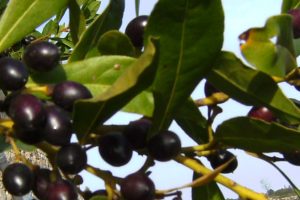
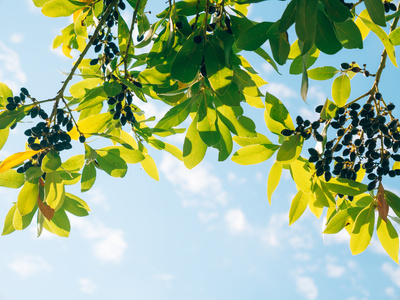
Fruit Glossy, red coloured berries form on female plants once the flowers have faded, transforming to black in September. The seeds found within the berries are poisonous.
Found in Formal gardens, residential patios, estate hedging; does well in coastal regions.

Conditions

Ideal soil Any fertile and moist but well-drained chalk, clay, sand or loam soil is ideal for the bay laurel tree
Soil pH Neutral, acid, alkaline
Aspect North, south, east or west facing
Exposure Full sun to partial shade. Needs stem protection in cold weather and should be sheltered from harsh winds to avoid damage.

Threats

Pests Bay sucker, horse chestnut scale, soft scale and tortrix moth
Diseases Powdery mildews, leaf spot

Bay Laurel Trees and Wildlife

Any plant that forms hedging has great value to wildlife, especially birds and bats which appreciate the refuge offered as well as the juicy berries, and butterflies, hover flies, ants and pollinating insects are attracted to the flowers. Small mammals will also take cover within the privacy of the year-round dense greenery.

Bay Laurel Tree Symbolism and History

In Greek mythology, Daphne the female nymph turned was turned into a laurel tree by her father Ladon, the river god, in order to save her from the god Apollo’s affections.

Ancient beliefs dictate that the laurel tree held magical powers and an ability to ward off evil witchcraft and disease. For the Greeks, bay laurel was a medicine that would provide protection against diseases, in particular the plague.

Both the ancient Romans and Greeks would wear bay laurel wreaths as a status symbol and to denote victory.

Bay laurel was widely used as a herbal medicine for conditions such as colic, renal problems and stomach issues, as recorded by monks in ancient handwritten medical journals.

The Importance of Bay Laurel Trees

Bay leaves in their dried form are commonly used in Italian cooking but because of their sharpness they are usually removed from a dish before serving.

Ground bay leaves are used widely in stocks and soups and are more easily digested than their whole counterparts.

The berries of the bay laurel and the oil of the leaf are also used for culinary purposes, and the wood of the tree can be burnt for smoke flavouring for meat and fish.

The bay laurel leaf produces an essential oil that is used in aromatherapy although it is generally mixed with other oils such as eucalyptus and lavender or heavily diluted with a carrier oil so that it can be safely used to alleviate muscle aches and pains, sprains and rheumatic ailments. Bay laurel oil is also said to be good for stimulating hair growth and treating dandruff as well as having a positive effect on the lymphatic system.

When combined with eucalyptus oil, bay laurel essential oil can assist with respiratory related conditions such as persistent cough and bronchitis. It also acts as an effective digestive aid.

Caring for a Bay Laurel Tree

In general, the bay laurel does not require much pruning, although topiary shrubs will need fairly regular pruning in order to maintain their shape, and bay laurel hedges will need careful pruning to keep their neat shape. August is the prime time for pruning hedges and more established plants that have outgrown their space can be carefully pruned back to ground level in spring and will as a result sprout back very rapidly.

There are various things to look out for when growing a bay laurel tree. Leaf spots are a result of waterlogged roots or just general wet weather. If you are growing your laurel tree in a container then you will find this happens quite a lot if the compost has not been renewed for a while. If this is the case, be sure to repot into fresh compost that is well-drained.

If you spot yellow leaves then this could be a sign of nutrient deficiency which could stem from waterlogging or damage caused by cold weather. Winter cold and varying moisture levels in the soil can also cause the bark to peel, although bay laurel tree owners should not be overly alarmed by this. Simply prune any dead parts back to the green, healthy wood.

Other issues to look out for include brown leaves and infestations of insects including the bay sucker and soft and horse chestnut scale.

If you have a bay laurel tree that could do with some professional care and attention, why not talk to Tree Works? As fully qualified and extensively experienced tree surgeons, we can offer extensive knowledge and skill across all aspects of bay laurel tree care. For a free, no-obligation quotation, call us on 07781 416 354 or get in touch here.
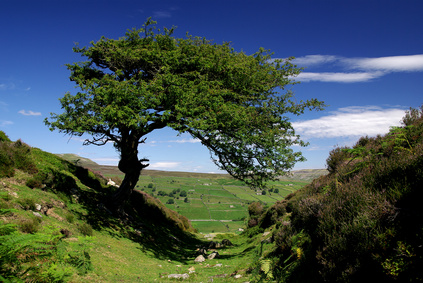
Beech Tree


Everything you need to know about the beech tree, from identification tips to typical characteristics; how to spot disease and the best way to maintain a beech tree.

The beech tree is a UK native species that is known to live for hundreds of years, sometimes even thousands with regular coppicing.

Beech trees have the potential to grow to over 40 metres in height and when mature typically develop a significantly sized domed crown. The beech is often confused with the hornbeam, although you can identify the beech by its characteristic wavy edged leaves as opposed to the hornbeam that has leaves bearing serrated margins.

Due to its longevity, the beech tree is important for wildlife and it also makes an excellent hedging plant: give it a careful, regular clipping and it will retain it leaves, so providing year-round privacy for both householders and birdlife.

General Facts

Known as Beech tree, common beech, European beech
Latin name Fagus sylvatica
Location Central Europe to Caucasus
Foliage Deciduous
Lifespan Several hundreds of years

Characteristics

Height Up to 40 metres
Spread 8 metres plus
Appearance A large and vigorous tree that grows very tall and develops a broad, domed crown. Bark is smooth, thin and grey and sometimes bears faint horizontal etchings.
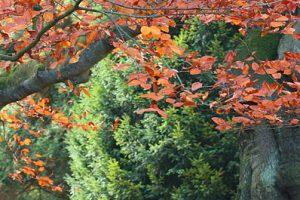
Leaves Leaves appear on stalks and are oval in shape with a pointed tip. The younger leaves of the beech tree are vibrant lime green and have silky hairs. As they develop, the leaves darken and lose their hairs, finally becoming a rich russet brown before falling in autumn. The characteristic wavy edge of the leaf makes
Flowers Both male and female flowers appear on the same tree in April and May. Male flowers are catkins that hang from long stalks off the end of twigs. Female flowers grow in pairs and are surrounded by a cup.
Fruit The cup surrounding the female flower starts to become woody and prickly after pollination. One or two triangular shaped green beech nuts, known as beechmast, will be found inside.
Found in Mostly woodland

Conditions

Ideal soil Moist but well drained, chalk, loam or limestone soil
Soil pH Neutral, acid, alkaline
Aspect North, south, east or west facing
Exposure Full sun to partial shade; can be sensitive to winter frost

Threats

Pests Aphids, beech bark scale
Diseases Coral spot, heart and root rot, beech bark disease

Beech Trees and Wildlife

The beech woodland provides a vital habitat for numerous butterflies. Caterpillars of the olive crescent, clay triple-lines and barred hook-tip moths very much enjoy the leaves and the seeds form a staple diet for birds, squirrels, mice and voles.

You’ll often find some rare plant species within the beech woodland, including various orchids and coralroot bitter-cress.

With the beech tree having such a long lifespan, it provides a comfortable home for deadwood loving wildlife such as wood-boring insects and hole-nesting birds. All sorts of fungi, lichens and mosses grow on the bark including native truffle fungi which plays an important role in assisting the tree in obtaining nutrients. This it does in exchange for a portion of the sugar the tree produces via photosynthesis.

Beech Tree Symbolism and History

Where the oak tree is considered the king of British trees, so the beech tree is thought of as the queen.

Fagus was the Celtic god of beech trees which were thought to have medicinal properties. The leaves would be used to reduce swelling and boiling them up would form a poultice used to treat scabs. Nowadays, beech essential oil is used in aromatherapy to boost hope and confidence.

Forked beech twigs are favourites for divining and it is said that a beech branch can be used as a wand to open communication channels with the spirit world. Folklore dictates that if you carry small pieces of beech bark in your pocket, you will experience luck and success, and that powdered beech wood, when placed in your right shoe, will lead you towards your fortune.

The Importance of Beech Trees

The timber of the beech tree serves numerous purposes. It is very popular in furniture making and produces fine natural wood veneers. It is also used to make sporting equipment, tool handles and cooking utensils. As the wood burns well, it makes a good fuel and is traditionally used in herring smoking.

Beech is commonly used as hedging as it will retain its leaves with careful clipping, which makes it much loved amongst birds and homeowners.

Caring for a Beech Tree

The beech tree is a low maintenance tree and only needs light pruning. Harder pruning of the beech tree could lead to serious problems, so it is essential to proceed with caution when pruning.

The key objective when pruning a beech tree is to maintain its ideal size and to keep it manageable and in good health. You should be seeking to enhance the tree’s aesthetic appeal, which means keeping pruning in proportion.

You should remove dead wood and prune out any branches that have been damaged by bad weather or insects or wildlife. You will also need to take out any branches growing too close together in order to promote good air flow and light penetration which will help to keep the tree in good health.

Tree surgeons will use crown thinning for this purpose, and they will also sometimes carry out crown lifting, which involves removing a few of the lower branches so as to prevent the tree interfering with traffic or passers-by.

If you see sunken, dead patches of bark and small holes in the leaves of your beech tree as well as a glue-like substance oozing from the bark, this could be down to bacterial canker. It is important to look for these symptoms before going ahead with any pruning as you may need to revise your schedule so as to make sure the tissues of the tree are at their most resistant when you make your cuts.

Beech bark disease, caused by a combination of canker fungus and the sap-sucking scale insect, is another known issue and in serious cases can result in the death of the tree. Phytophtora root rot which shows itself as sparse, yellowing or wilting leaves and dieback of branches, and bark stripping via the habits of the grey squirrel can also be common issues for the beech tree.

Over-pruning of beech trees by inexperienced persons is sadly far too prevalent and can cause irreparable damage to the tree. Also, as the beech tree reaches towering heights, it is of course extremely hazardous to attempt any form of work without the right equipment, insurance and expertise.

A qualified tree surgeon will know exactly how and when to prune a beech tree for best results. They will also be clued up to spot the common and often serious diseases associated with this particular tree, and will know how to handle them so that the tree has the very best chance of survival.

If you have a beech tree that could do with some expert care and attention, why not talk to Tree Works? As fully qualified and extensively experienced tree surgeons, we can offer in-depth knowledge and skill across all aspects of beech tree care. For a free, no-obligation quotation, call us on 07781 416 354 or get in touch here.
1 2 3